


ASUS expects laptop prices to rise by up to 45% by Q3 2026 compared to December 2025, driven by a surge in memory chip costs.
The company has already implemented about 10% price hikes in the first quarter.
Further 20–30% increases likely in Q2 as RAM and SSD prices spike beyond CPUs.
Taiwanese laptop maker ASUS expects prices of its devices to rise by as much as 45% by the third quarter of 2026 compared to December 2025, before stabilising, as memory chip prices surge, according to its India unit Vice President Arnold Su. The company, which controls about 20% of India’s commercial PC market, has already passed on price hikes of around 10% in the first three months of this year.
“In Q2, we expect end-user prices to increase by around 20–30%. The primary reason is the sharp rise in prices of RAM and SSDs. The increase has been significant to the point where RAM and SSDs are now more expensive than CPUs, which is unprecedented,” said the Vice President of Consumer and Gaming PCs at ASUS India.

1 April 2026
Get the latest issue of Outlook Business

Despite the price hikes, ASUS India executive say customers are willing to pay slightly more for better machines. ASUS saw total shipments jump nearly 19% year-on-year in 2025, according to IDC data. In the overall PC market, its share grew from 7% to 7.6%.
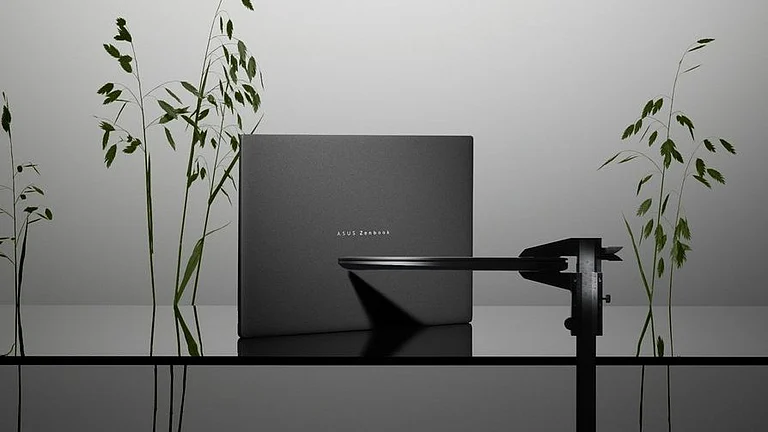



“Our premium range, which is priced at ₹80,000 and above, earlier accounted for around 30–35% of our total business and has now increased to almost 40%. This shows a shift in customer behaviour,” Su told Outlook Business. On Tuesday, the company opened pre-bookings in India for its premium Zenbook range, including the Zenbook S14, Zenbook Duo, Zenbook A14.
The Zenbook series is priced starting at ₹1,79,990 for the S14, while the Duo comes at ₹2,99,990. The A14 starts at ₹1,85,990 and the A16 at ₹1,99,990. Vivobook models begin at ₹98,990 for the 14-inch version and ₹1,01,990 for the 16-inch variant, while the Vivobook S14 and S16 are priced at ₹1,28,990 and ₹1,31,990 respectively. Pre-orders for the Zenbook range are open from April 14 to April 20.
What's Behind the Rising Laptop Prices?
Earlier, a CPU would typically account for around 20% of a laptop’s total cost, while SSDs and RAM together would be around 5%. But rising demand for memory chips due to the build-out of data centres globally has led to a demand-supply mismatch, pushing RAM and SSDs to account for more than 20–30% of total machine costs.
“This shift is the main driver of the ongoing price increase,” Su explained, adding that the company expects prices to stabilise by the end of Q4. However, that does not mean there is any chance of prices coming down this year due to strong demand from AI-related workloads.
Outlook Business has reported how rising memory chip prices have led smartphone makers to hike prices across models by late 2025 and in March–April 2026. A similar hike is also being seen in the personal computer segment, with PC prices rising over 10% year-on-year in 2025, according to data from IDC. The market research agency expects this to further rise by 15–20% in 2026.

Consumers opt for EMI Payments
Amid the price hikes, Arnold Su says more users are choosing EMI-based purchases, which could become “one of the key levers for us going forward.”
“In 2025, the average no-cost EMI adoption was around 20–25%. But in Q1 (January–March), it has already increased to almost 30%. This is an increase of about 10–15 percentage points, which shows that more and more customers are choosing EMI-based purchases,” he said.
To double down on this trend, the Taiwanese firm aims to expand its no-cost EMI schemes throughout the year to improve affordability. The company earlier offered no-cost EMIs mainly during promotional seasons. Su expects more brands to adopt a similar route.
“It’s very difficult for any brand to really absorb this price hike. You may say the price difference is a few percentage points; maybe some brands will still try to manage it. But because it is a 30% hike, it is really tough for any brand,” he added.
Earlier this week, the company opened pre-bookings in India for its premium Zenbook range, including the Zenbook S14, Zenbook Duo, Zenbook A14, along with the Zenbook A16 and an updated Vivobook lineup.
The new lineup introduces ASUS’ Ceraluminum build, aimed at improving durability while keeping devices lightweight. The Zenbook S14 features a slim design with a 14-inch 3K OLED display and support for Intel Core Ultra processors with AI capabilities.
The Zenbook Duo stands out with its dual 14-inch OLED screens and high refresh rate, targeting users focused on multitasking. It is powered by Intel Core Ultra chips and supports multiple usage modes for different workflows.
The Zenbook A14 and A16 are powered by Snapdragon X series processors and focus on AI-driven performance and extended battery life. The A14 prioritises portability with a sub-1kg design, while the A16 offers a larger display and higher configuration options.
“While the Zenbook S series has existed for years, we had not focused heavily on it earlier. However, we are now seeing increasing customer demand for high-performance premium laptops, so we are putting greater emphasis on this segment,” Su said.
ASUS also plans to expand its retail presence, increasing its exclusive ASUS stores across key markets from 320 stores to about 400 stores in 2026.